Mercury retrograde: what actually moves, and what doesn't
Published on
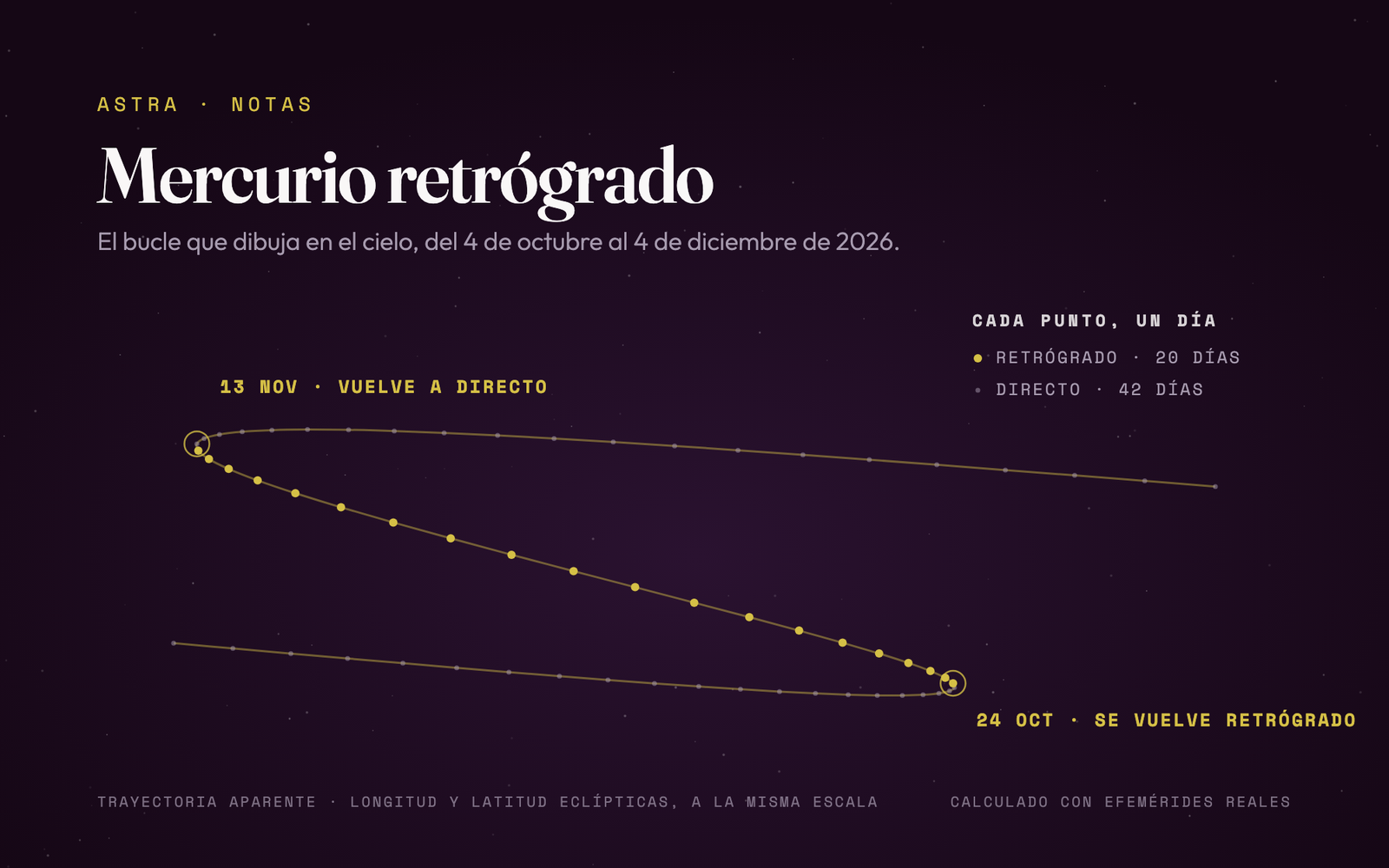
It's the one astrology term that made it into everyday conversation. A meeting falls through, a message goes missing, the flight is late: must be Mercury retrograde. And yet almost nobody knows what is retrograde, or what it's supposed to do.
Let's start with what actually happens in the sky, which can be measured rather than argued about.
Mercury doesn't go backwards
No planet changes direction. They all orbit the Sun the same way round, and none of them ever slows to a stop. What changes is where you're watching from.
Mercury goes around the Sun in 88 days; Earth takes 365. Every so often we catch up and pass it on the inside, the way you overtake a slower car in the next lane: for as long as the overtaking lasts, the other car seems to slide backwards against the scenery. It didn't brake — you're passing it. Here, the scenery is the stars.
That's retrograde motion: not a change in the orbit, a change in the point of view. And it isn't Mercury's alone. Every planet does it as seen from Earth — Venus, Mars, Jupiter, Saturn — each on its own rhythm. Mercury got famous because it does it most often: three times a year, every year.
The ℞ in your table is exactly that
When you generate your chart, some planets show an ℞ next to them. It doesn't mean that planet was broken or switched off the day you were born. It means one thing, and it's literal: on that day, seen from Earth, it was moving the other way against the backdrop of the zodiac.
It's a fact about position, the same kind of fact as the degree and the sign. It's computed, not interpreted.
When it happens, with dates
These are the three retrogrades of 2026 and the three of 2027, computed with the same ephemeris ASTRA uses to build your chart. Times are UTC, so depending on where you live a date may shift by a day either way.
- 26 February to 20 March 2026, in Pisces.
- 29 June to 23 July 2026, in Cancer.
- 24 October to 13 November 2026, in Scorpio. This is the next one.
- 9 February to 3 March 2027, from Pisces into Aquarius.
- 10 June to 4 July 2027, from Cancer into Gemini.
- 7 to 28 October 2027, from Scorpio into Libra.
Added up, that's 66 days out of the 365 in 2026: Mercury spends roughly 18% of the time retrograde. Almost one day in five. Worth keeping in mind before blaming a bad week on it — this is a fairly ordinary state of the sky, not a rare event.
How far back it goes, in degrees
Not far, and not fast. During the October retrograde, Mercury covers just under 16 degrees backwards in 20 days: it goes back over a stretch of sky it had already crossed, without ever leaving Scorpio.
The change of speed is measurable too. Moving direct, Mercury advances up to 2.19 degrees a day. Moving retrograde, it slips back at most 1.31 degrees a day. There's no sudden stop: there's a slowdown, a slow second pass over the same ground, and then forward again.
What the tradition says, and what the sky doesn't
Here the two things are worth separating honestly, which is what this section is for.
Astronomy describes a geometry: an inner planet being overtaken by Earth. That's all there is. There is no physical mechanism by which that geometry breaks a phone, deletes a file, or makes someone reply badly to a message. Mercury sits between 85 and 216 million kilometres away depending on the time of year, and the only force it exerts on your daily life is a gravitational pull far weaker than the building across the street.
Astrology, for its part, is a symbolic language that has been reading these cycles for millennia, and it associates Mercury's retrograde with whatever comes back around: reviewing, rereading, resuming, correcting. Taken that way — as a convention for organising time, not as a cause — it has a concrete use: it's a scheduled prompt to go back over things left half done.
What it isn't is an explanation. If the flight was late, it was late because of the flight. A coincidence with a transit doesn't make the transit its cause, and confusing the two is what makes astrology read as superstition instead of what it can be: a vocabulary for thinking about yourself.
If you were born with Mercury retrograde
You're in a large group. If Mercury is retrograde around 18% of the time, roughly one person in five was born with the ℞ in their chart. It isn't a rare mark or a factory defect: it's a common position.
The traditional reading associates it with a mind that circles before it speaks: processing inward, going back over what was said, understanding by rereading. None of that is proven, and it's best taken for what it is — a description to try on, not a diagnosis. But it's a good deal more interesting than the version everyone repeats.
If you want to know whether you have it, it's in the positions table of your chart, in the ℞ column. Generate your chart with your date, time and place, and see which planets carry it.
And if you're still wondering what each piece of that table measures, that's in the other notes: Sun, Moon and Rising: three things that aren't the same.